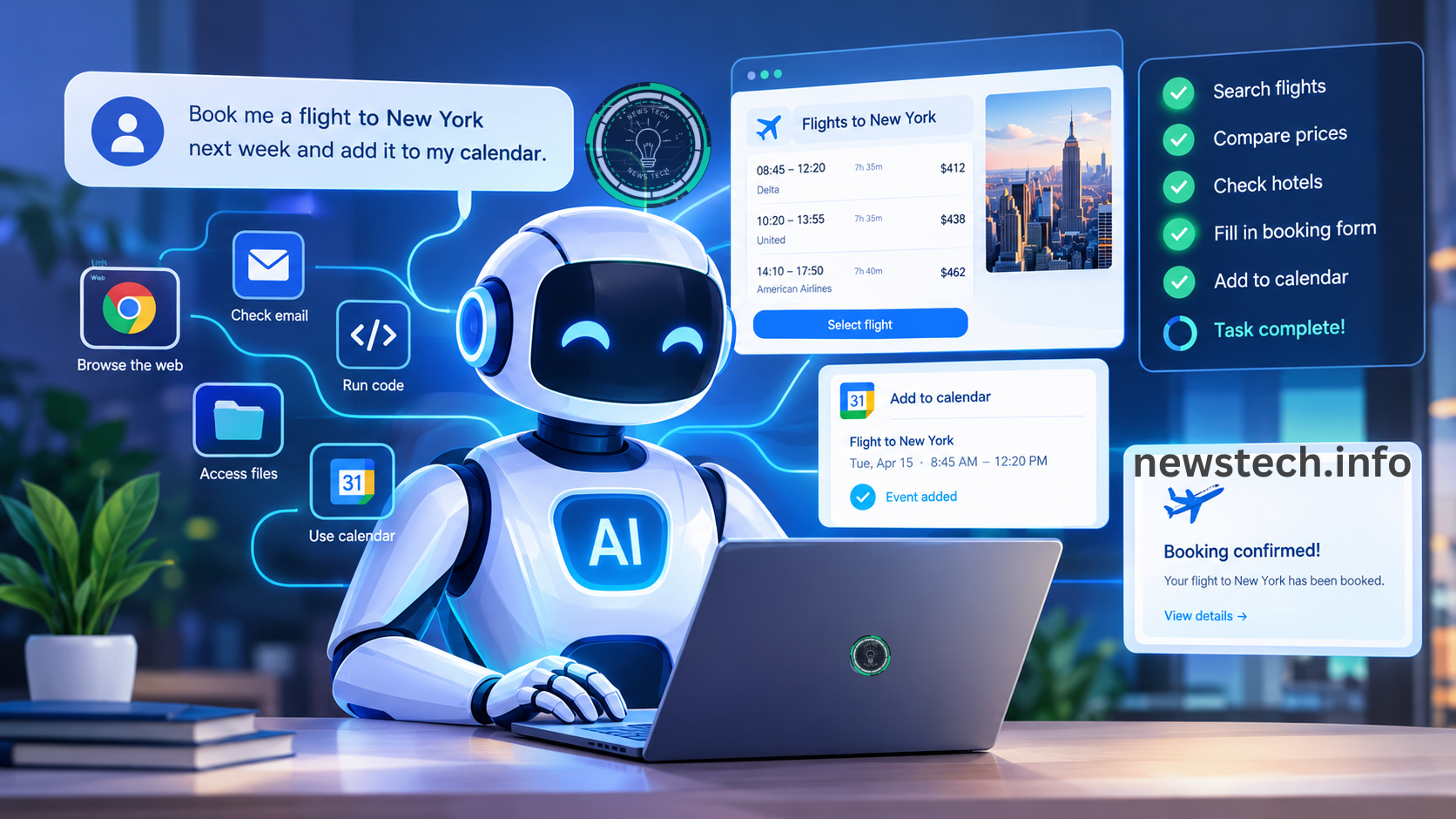
Ask a chatbot to book you a flight, and it might explain how to search for one, compare some options, or even give you a link.
Ask an AI agent to do the same thing, and the goal is different: it can search for flights, compare options, work through websites, fill in information, and potentially complete parts of the task for you — while asking for confirmation when an important action requires it.
That difference — between an AI that tells you how to do something and an AI that can take steps to do it for you — is at the heart of what people mean by agentic AI. And in 2026, that idea is becoming much harder to dismiss as just an AI buzzword.
The technology is appearing in browsers, coding tools, search, business software and even early forms of agentic commerce. At the same time, companies are discovering that giving AI the ability to act creates an entirely new set of reliability and security problems.
So what exactly is agentic AI, and why is everyone suddenly talking about it?
What Agentic AI Actually Means
A chatbot primarily responds to a prompt. An AI agent is designed to pursue a goal. That sounds like a small difference, but it changes how the software works.
A traditional chatbot might answer:
“How do I plan a three-day trip to New York?”
An agentic system could potentially take that goal and turn it into a sequence of actions: research destinations, check travel options, compare hotels, organize the information and create an itinerary.
The important part isn’t that the AI is magically “thinking like a human.” Instead, an agent can combine several capabilities:
- Understanding a goal
- Breaking that goal into smaller tasks
- Choosing which tools to use
- Accessing information or software
- Taking actions
- Checking the results
- Adjusting its approach when something doesn’t work
- Asking a person for confirmation when necessary
IBM describes agentic AI as systems capable of accomplishing goals with limited supervision, while Microsoft describes agents as systems that can plan multi-step tasks and interact with tools and business systems.
That’s why the simplest way to think about it is: Chatbots answer. Agents act.
There is plenty of overlap between the two, and not every product marketed as an “agent” is equally autonomous. But the shift from generating an answer to executing a workflow is the important part.
If you want the basics of how agents compare with traditional chatbots, our earlier article on AI agents vs. chatbots covers that distinction in more detail.
Why Is Agentic AI Suddenly Big in 2026?
Agentic AI isn’t actually new. Researchers and software companies have been working on AI systems that use tools, plan tasks and interact with computers for years.
What’s changed is the combination of better models, better tools and better integrations.
Modern AI systems are increasingly capable of handling longer, more complicated workflows. They can work with browsers, files, code, APIs and business applications instead of being limited to a text box.
OpenAI, Google, Microsoft, Anthropic and Perplexity are all pushing toward systems that can perform multi-step work rather than simply generate text.
That doesn’t mean AI agents are suddenly reliable at everything. It means the technology has reached a point where delegating certain types of work to AI is becoming practical enough to use outside research demonstrations. And businesses are paying attention.
Gartner predicts that 40% of enterprise applications will integrate task-specific AI agents by the end of 2026, up from less than 5% in 2025. Gartner has also warned that poor governance could cause organizations to scale back or abandon autonomous agents.
That’s a much more interesting story than simply saying “AI agents are the future“. The future is already being tested. The question is how far it can actually go.
What Does Agentic AI Look Like Right Now?
You don’t have to look very far to find examples.
Agentic Browsers
One of the easiest ways to understand agentic AI is through the browser. Instead of manually opening multiple tabs, searching websites and copying information between them, an agent can potentially perform several of those steps itself.
Perplexity’s Comet, for example, describes itself as a personal AI assistant capable of automating tasks, researching the web, organizing email and handling activities such as planning vacations and ordering groceries. Its enterprise version can also perform tasks such as finding flights, scheduling meetings and filling out web forms, while requiring confirmation for important or sensitive actions.
Google is also pushing agentic capabilities into Search, including systems designed to perform tasks from natural-language requests.
OpenAI has taken a similar direction with computer-using and browser-based capabilities. Its earlier ChatGPT Atlas browser was explicitly designed around agentic browsing, but OpenAI is now deprecating Atlas and moving those lessons and capabilities into ChatGPT and Codex.
That change itself is revealing. The industry isn’t necessarily converging on “one special AI browser.” Instead, agentic capabilities are increasingly becoming features that can be built directly into the software people already use.
Coding Agents
Coding is another area where agents are particularly useful. A traditional AI coding assistant might suggest a function or generate a piece of code. A coding agent can go considerably further. It can inspect a project, modify files, run tests, identify errors and make additional changes.
OpenAI’s Codex, for example, is designed around end-to-end engineering tasks including building features, refactoring code, reviewing changes and working across multiple agentic workflows.
That doesn’t mean developers can simply walk away from every project and let AI handle everything. But it does change the role of AI from code generator to software worker.
Multi-Agent Systems
Sometimes one AI agent isn’t enough. A larger workflow can be divided among multiple specialized agents. One agent might research information. Another might analyze the results and another could write a draft. A separate agent could check the work. This approach is commonly described as a multi-agent system.
The idea is similar to giving different employees different responsibilities instead of asking one person to do everything.
Google, Microsoft and other major technology companies are increasingly building infrastructure around these kinds of agentic workflows.
Agentic Commerce Is Becoming Real, Too
Shopping is another area where agentic AI could change everyday internet use. For years, AI has been good at recommending products. The next step is allowing an agent to act on those recommendations.
Google has been developing tools and standards designed for an “agentic shopping era,” where AI systems can interact with retailers and help turn a user’s intent into an actual commerce workflow.
India is also exploring this idea at the payments level. Reuters reported in September 2026 that India is preparing a framework for agentic payments through UPI, allowing AI agents to make certain low-value digital payments under defined controls such as spending limits, identity checks and delegated authorization.
That is an important development because it shows where agentic AI ultimately gets interesting — not when it can write another paragraph of text, but when it can interact with the systems that people already use to get things done.
The Big Difference: AI That Acts
This is the fundamental change behind the hype. For years, generative AI has mostly been about producing something:
- Text
- Images
- Code
- Summaries
- Ideas
- Answers
Agentic AI adds another layer: Action.
Instead of asking: “What’s the cheapest way to travel to Delhi?“
You could eventually say: “Find me the best option under my budget, check my calendar, and prepare the booking.“
The AI isn’t merely generating information anymore. It is interacting with other systems. And that’s where things become much more powerful — and much more complicated.
The Part Nobody Has Fully Solved Yet
Giving an AI the ability to act creates a security problem that doesn’t exist in quite the same way when the AI is simply answering questions.
→ Consider a browser agent.
→ It visits a website.
→ That website contains instructions.
But how does the agent know whether those instructions are legitimate information from the website or malicious instructions designed to manipulate the AI? This is known as prompt injection.
Security researchers at OpenAI and Anthropic have identified prompt injection as a major challenge for browser and computer-using agents. An attacker can hide instructions inside content that an agent is processing and attempt to persuade it to perform an action that conflicts with the user’s actual request.
Google has taken a similar approach in its agentic browser security work, emphasizing transparency, action logs and the ability for users to pause or take control during sensitive operations.
This is why a truly useful AI agent can’t simply be “more autonomous“. It also needs:
- Permission controls
- Clear boundaries
- Human confirmation for sensitive actions
- Activity logs
- Secure connections to external systems
- Protection against malicious instructions
- The ability to stop or undo actions where possible
In other words, autonomy without control isn’t a feature. It’s a liability.
Is Agentic AI Actually Useful, or Is It Mostly Hype?

The honest answer is: both.
Agentic AI is already capable of performing real tasks. But that doesn’t mean every task should be handed over to an autonomous system. The technology is particularly attractive for tasks that are:
- Repetitive
- Well-defined
- Multi-step
- Time-consuming
- Relatively low-risk
- Easy to verify
Research, data gathering, scheduling, software testing and routine business workflows can all be good candidates. The situation changes when the task involves major financial, legal, medical or personal consequences.
A recent study of industrial AI adoption found that organizations are experimenting with increasingly sophisticated agents, but production deployment is still constrained by problems such as verification, confidentiality, non-deterministic behavior and integration challenges.
That’s the part of the agentic AI story that gets less attention. Making an AI capable of completing a task is one problem. Making it reliably complete that task without creating a bigger problem is another.
Why Companies Are Interested
For businesses, the attraction is obvious. Imagine a customer-support agent that doesn’t just explain a company’s return policy but can actually process a straightforward return. Or a software-development agent that doesn’t merely suggest code but can create a branch, make changes and run tests. Or an internal business agent that can gather information from several systems and prepare a report.
The potential isn’t simply about replacing a chatbot. It’s about turning AI into a layer that can interact with the software a company already uses.
Microsoft is explicitly working toward this model, describing agents as a way to automate workflows and integrate AI into everyday business operations.
Gartner’s forecasts also suggest that agentic capabilities could have a substantial impact on enterprise software. In July 2026, Gartner estimated that up to $234 billion in enterprise application spending could be exposed to “agentic arbitrage” by 2030.
That doesn’t mean $234 billion will simply disappear.
It means the way companies buy and use software could change if AI agents increasingly perform work across multiple applications instead of humans interacting with every application directly. That’s a much bigger shift.
What This Means for You
You don’t need to become an AI engineer to understand what’s happening. The most important distinction is simple:
→ Is the AI answering you, or is it acting on your behalf?
If it is only answering questions, a mistake might give you bad information. If it is acting, a mistake could cause something to actually happen. That could mean:
- Sending an email
- Changing a document
- Submitting a form
- Scheduling a meeting
- Buying something
- Sharing information
- Changing a setting
- Accessing an account
The more authority you give an AI system, the more important its permissions and safeguards become. That’s why the next stage of AI isn’t really about whether machines can generate better text.
It’s about whether people are comfortable letting AI make decisions and take actions inside the digital world.
So, Is 2026 the Year of Agentic AI?
Maybe — but not because AI agents suddenly became fully autonomous. The more accurate story is that 2026 is becoming an important inflection point.
Major technology companies are embedding agents into search, browsers, coding environments, productivity software and enterprise systems. Businesses are experimenting with real workflows, while researchers and security teams are simultaneously discovering how difficult it is to make autonomous systems reliable and safe.
That’s why the agentic AI conversation feels different from the chatbot boom. Chatbots changed how we get information. Agents are trying to change how we get things done. And if the technology continues to improve, that difference could become one of the biggest changes in everyday computing over the next few years.
For now, though, the smartest approach isn’t to blindly trust every new “AI agent” announcement. It’s to understand what the agent can actually do, what permissions it has, what actions require your approval, and what happens if it makes a mistake.
Because once AI can act for you, trust becomes just as important as intelligence.
Frequently Asked Questions
A chatbot generally responds to a prompt, while an AI agent can pursue a goal through multiple steps. Agents can use tools, access information, take actions and adjust their approach based on the results.
No. Agentic AI describes how an AI system operates — particularly its ability to plan, use tools and perform tasks with varying degrees of autonomy. AGI refers to the broader concept of artificial general intelligence capable of performing a wide range of intellectual tasks at a general level. An AI agent can therefore be highly capable at a specific workflow without being AGI.
Examples include AI-powered browsers and assistants such as Perplexity Comet, agentic coding systems such as OpenAI Codex, Google’s agentic Search capabilities, and enterprise agents designed to automate business workflows.
It can be useful for well-defined, lower-risk tasks, but autonomous systems introduce additional security risks. Prompt injection, excessive permissions, unreliable decisions and unintended actions are among the issues developers are working to address. For tasks involving money, sensitive information or irreversible actions, human oversight remains important.
You don’t need to learn how to build an AI agent. The useful skill is understanding what an AI tool is allowed to do. Before giving an agent access to your accounts, files, email or payment systems, check its permissions and understand which actions require your confirmation. The more powerful the agent becomes, the more important that distinction will be.
Leave a Reply